
Bloomington City Directory Holdings by Year
The cleanest exact set lives in Hennepin County Library's digital collection. Four Bloomington titles run from 1963 through 1966. The title browser labels them plainly as Bloomington City Directories. That is a firmer starting point than treating every Minneapolis book as a Bloomington source. Older and nearby volumes cover different ground. Each title still needs a check of the place it actually serves. Only then does it count as local evidence.
| Collection | Years located | Where held | Access route |
|---|---|---|---|
| Bloomington City Directories | 1963-1966, four titles | Hennepin Library ResCarta collection | Free online viewer with exact-text and address searching |
| Minneapolis City Directories | 1859-1963 | Hennepin digital collection and Special Collections | Free scans; address browsing begins in 1930 under the library guide |
| Hennepin suburban directory runs | Varies by city, including Edina, Hopkins, Richfield, and St. Louis Park | Hennepin digital collection | Use only when a title's geographic coverage includes the address |
| Telephone books and MNHS holdings | Incomplete Bloomington coverage confirmed | MNHS catalog and Special Collections | Onsite research or paid one-name service |
Publisher facets appear in the browser. But they do not prove one publisher behind all four Bloomington volumes. Read each title page before citing anyone. The collection likewise cannot promise that every person or address appears in every year. Note: A missing year or name is a lead to test with another record. It is not proof that a Bloomington household was absent.
Bloomington City Directories Online
Start with the Hennepin digital title browser for the local 1963-1966 run. Its Simple Search spans selected directories at once. Matching against the OCR text has to be close. Capitalization does not matter. A surname alone, followed by alphabetical browsing, usually beats a long modern-style name query.
The library's search guidance permits * to stand in for any number of missing characters. It permits ? for exactly one. Neither works at the start of a query. Boolean wording finds nothing. Street names shift between Av, Ave., abbreviated numbered streets, and longer local forms. Try the variants the volume you are working with actually uses.
The Hennepin digital city-directory collection page displays the full set of digitized volumes.
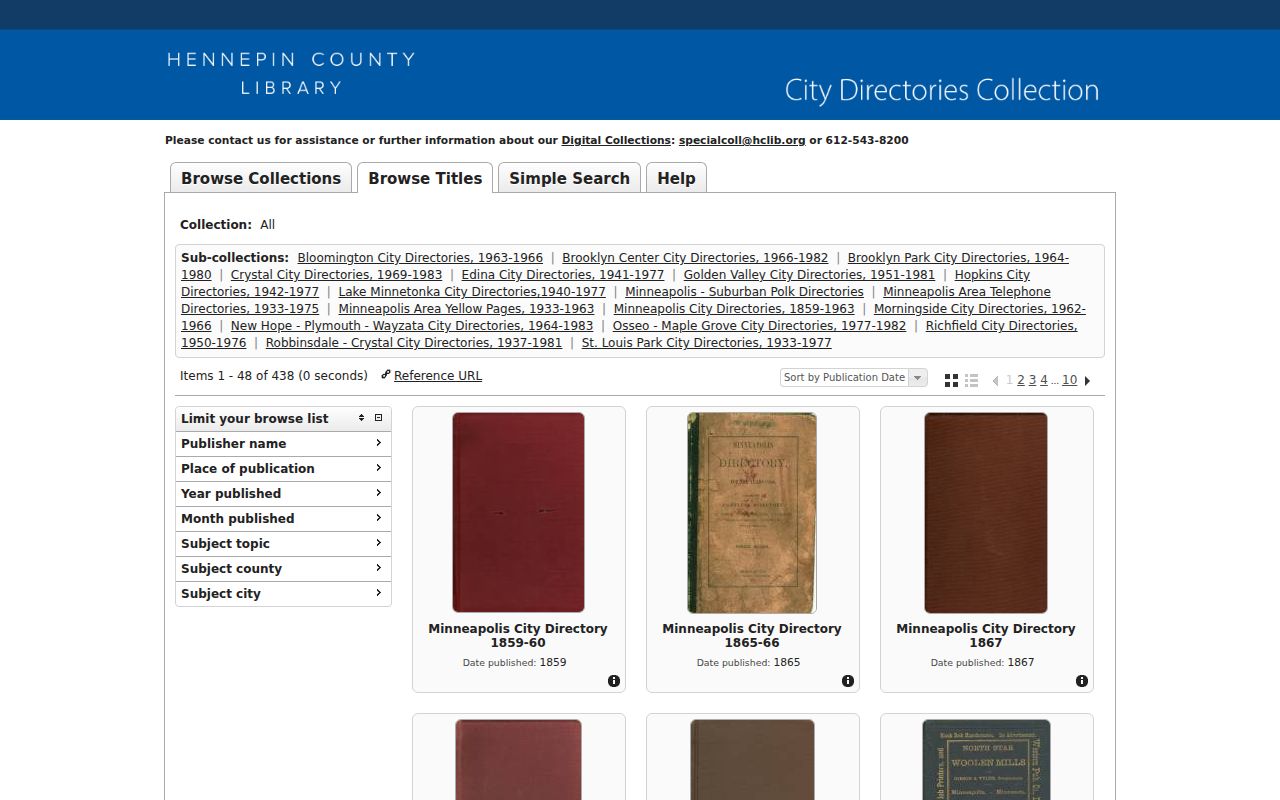
Apply the title and subject-city filters first. That keeps the search tied to Bloomington before any expansion into regional books.
Reading a Bloomington City Directory
A city directory entry is compact evidence, not a full household record. The Hennepin guide's worked example is a 1925 Minneapolis scan from the same service rather than a Bloomington entry, so it teaches conventions without inventing local names. Read the page image together with its abbreviation list. Meanings shift from one year to the next.
| Name order | Surnames commonly appear first. Repeated surnames may be replaced by ditto marks. |
|---|---|
| Address | A street address follows the name and may have a residence-type prefix. |
| Spouse notation | A spouse can appear in parentheses after the household head, though early books may omit that detail. |
| Occupation or category | Many entries include an occupation, and directories can index businesses by name or subject category. |
| Residence marks | r, b, and h require the book's own key because their meanings vary by year. |
- Criss-cross directory
- A directory arranged by street address instead of surname. Hennepin's guide discusses reverse address searching, but a Bloomington criss-cross run was not confirmed.
- Householder index
- An index that favors the person treated as the household head. It can leave out minors and some spouses.
- Abbreviation key
- The explanatory list printed in a volume. Check it before interpreting street forms or residence marks.
Women may appear on their own lines when living independently, widowed, divorced, or otherwise entered that way. An omission reflects the compilation, not a conclusion about a person.
Bloomington City Directory Research at HCLIB
When the screen does not settle a question, Hennepin County Library Special Collections at Minneapolis Central holds the broader Minneapolis and Hennepin County Collection. The room sits on the fourth floor, needs no appointment, and recommends advance contact. Its posted hours are Monday through Thursday, 9 a.m. to 4:30 p.m. Staff help may be available. So may scans, photography, copying, and email delivery for smaller files. All of it is subject to condition and copyright.
The Hennepin Special Collections page documents the local-history room. It also covers its books, photographs, maps, manuscripts, yearbooks, periodicals, websites, and newspaper-clipping files.
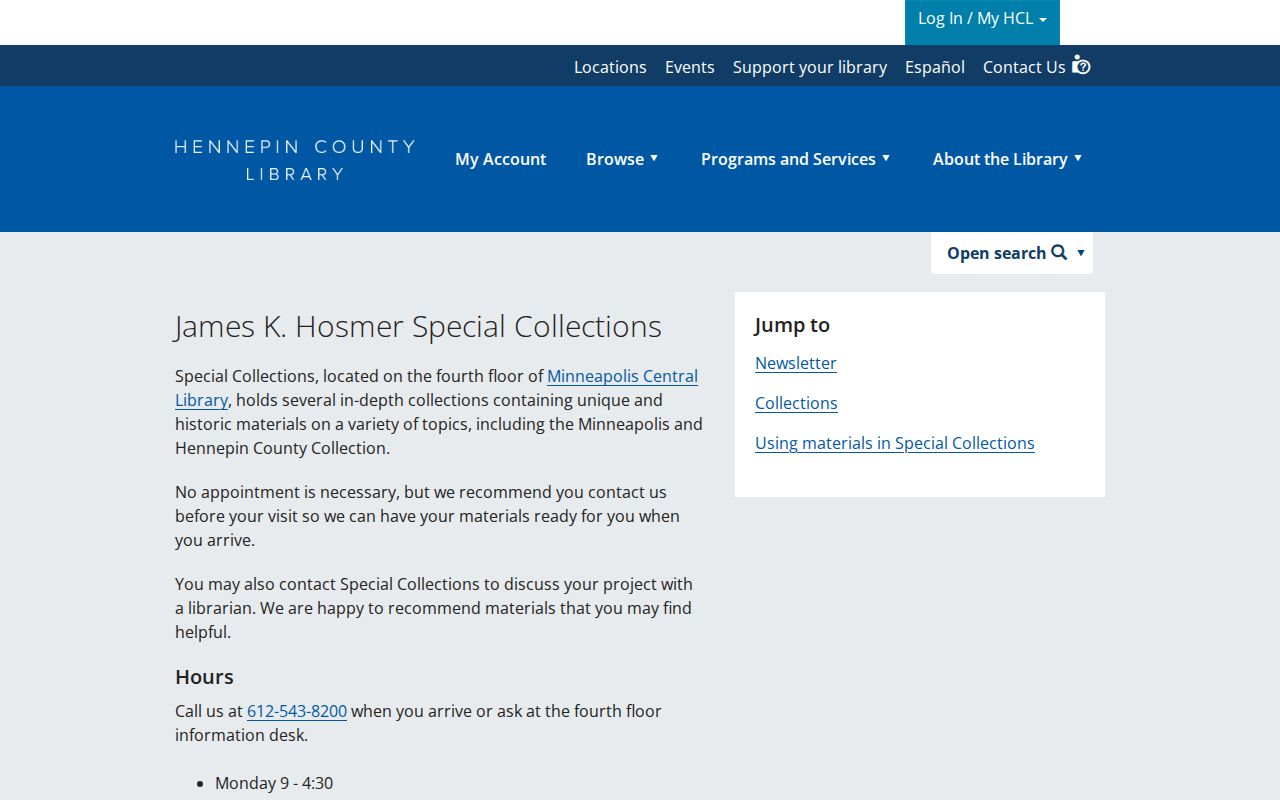
That physical shelf shines when a digital hit needs comparison with a map, a clipping, a school record, or a volume outside the exact Bloomington run. For records the city itself holds, Bloomington's public WebLink and data-practices channels are separate routes. They can supply civic context. They are not substitutes for a historical city directory.
Tracing a Bloomington Household Through Directories
Treat the local volumes as dated snapshots. Begin with the current or known address, keeping any alternate street spelling alive. Then search the 1963-1966 Bloomington titles by surname and by address. Inspect every hit in a year. One single-family address can return several listed occupants. The viewer's previous and next controls may surface still more.
- Normalize the address with PINS, the legal description, and USPS formatting. Keep alternate street forms in the notes.
- Search the four exact Bloomington volumes for surname and address variants, then review each result rather than stopping at the first hit.
- Expand to a regional directory only after its stated coverage makes it relevant to Bloomington or its suburbs.
- Compare household-head changes, spouse parentheses, residence marks, and address shifts from one year to the next.
- Pair a directory year with the closest census, deed, cemetery, obituary, or permit record to test timing.
- Read each year's abbreviation page before treating a mark as a move, ownership signal, or relationship clue.
The Minnesota Historical Society city-directory search service will check one name across up to five years of one city's directories or phone books. The posted price is $10 for a city-directory search, with digital delivery or scanning included. The ordinary turnaround runs three to four weeks, with longer delays possible. Its limits matter. Directories were not published for every place or year. Head-of-household practice can obscure children and some women. Confirm a promising name with a separate dated record. The MNHS city-directory search-service source page shows the request form and its terms.
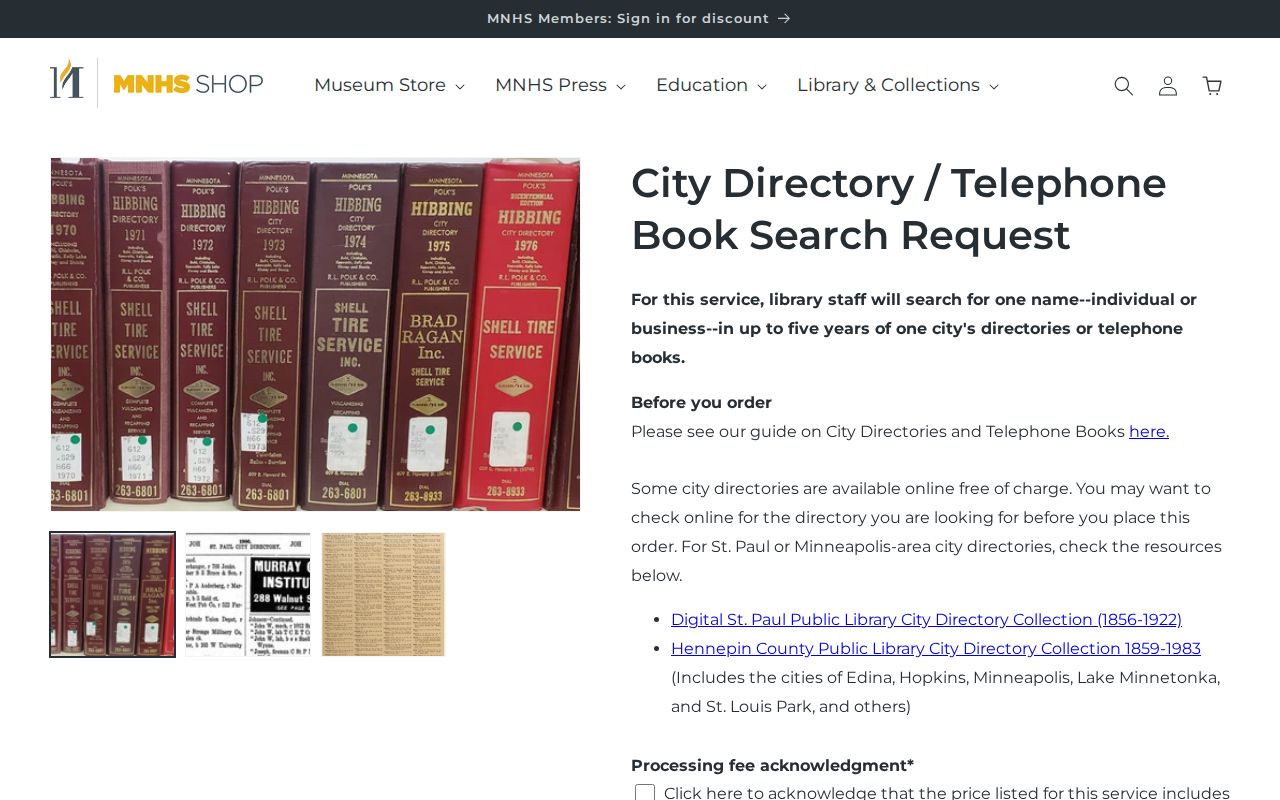
The service is a useful fallback for a focused historical question. It does not replace reviewing the wording and abbreviations in an original volume.
Bloomington City Directories Beside Yearbooks
Yearbooks fill the gaps between city directory years quite nicely. A student appears in one city directory. The student may then vanish from the next. School annuals often catch the missing years in between. Hennepin County Library holds Bloomington High School's Bear in print for 1954. The run resumes in 1956 and continues through 1964. Its catalog also covers Bloomington Junior High, Kennedy High, and Valley View Middle School. Normandale Community College appears there too. The years available differ from school to school.
For the full set of school holdings, browse the Hennepin County yearbooks collection. Pairing those volumes with the residents directory makes tracing a family across decades far easier.
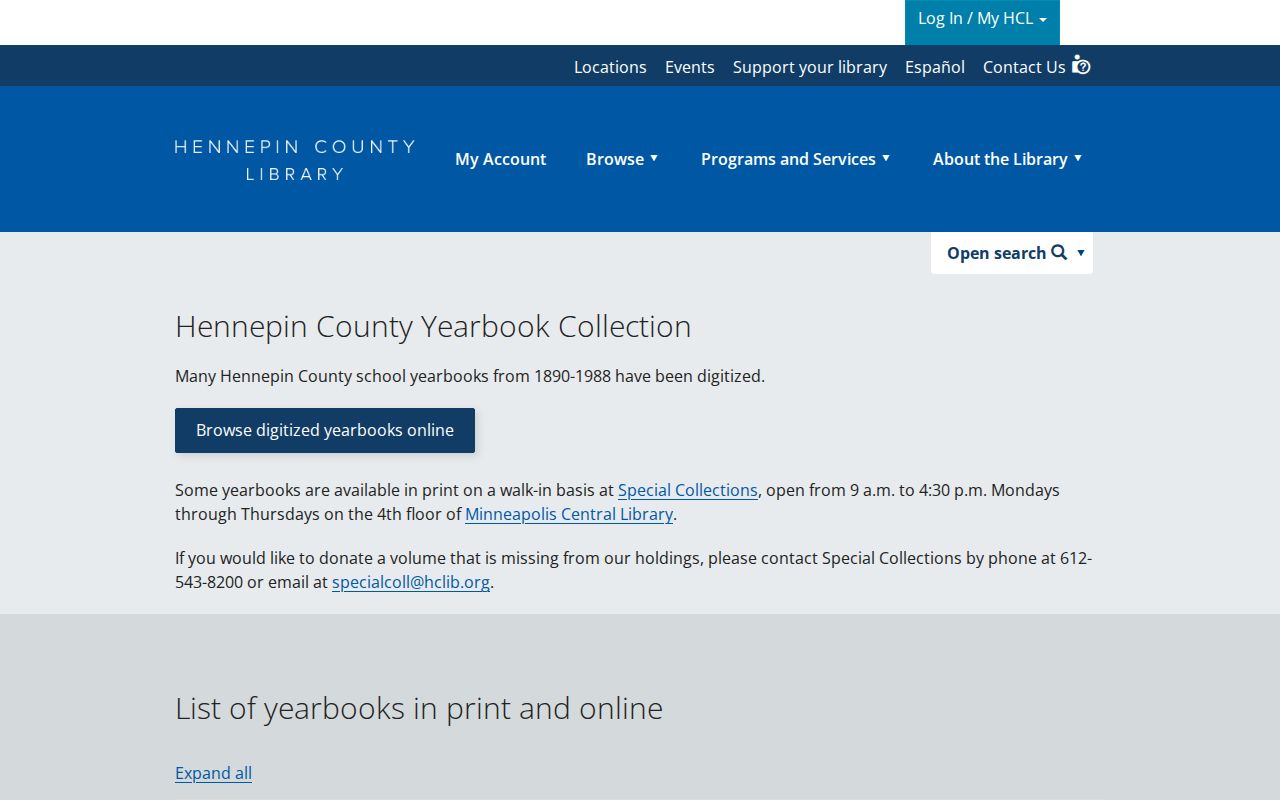
Verify years against the live catalog first. A missing volume in one place does not mean that school's run is broken everywhere, and digitized sets rarely cover every institution continuously.
Yearbooks and directories answer different questions. A yearbook gives you a school and a face. A Bloomington city directory gives a name tied to a street in one year. Use them together, but trust neither alone for household members or unbroken residence.
Bloomington City Directories and Old Town Hall
Bloomington's paper trail starts long before its four digital directory titles. The community organized as a town in 1858. It did not incorporate as a city until 1960. Its 1892 town hall served until 1964. For that reason, a nineteenth-century or early twentieth-century lookup often leans on township records, cemetery files, census schedules, newspapers, and county holdings. A Bloomington city directory rarely covers those years.
The Bloomington Historical Society museum research area holds bound early Bloomington newspapers covering 1930 through 1960. It also holds issues from the 1970s. More recent copies of the Sun Current may sit in the basement archives. Ask the museum host to point you to them.
A newspaper can carry a directory name further than the directory itself. Obituaries, civic notices, and event items often confirm relationships or fix an address spelling that OCR mangled in the residents directory.
| 1858 | Bloomington became a town on Minnesota statehood day; township and county records are important for this era. |
|---|---|
| 1892 | The town hall was built, creating the Old Town Hall historical anchor. |
| 1960 | Bloomington became a city, followed by rapid civic and street growth. |
| 1963-1966 | HCLIB's exact digital Bloomington city-directory run supplies four local snapshots. |
Bloomington City Directory Gaps and Checks
Gaps before 1963 send many researchers to nearby Hennepin directories. Treat those as comparison sources, not automatic Bloomington coverage. Minneapolis titles span 1859 to 1963. Each suburban run carries its own dates. Federal census schedules and Minnesota state-census microfilm each test a lead differently. Cemetery records, county deeds, and the Historical Society newspapers offer further checks on a name.
Hennepin's digitized pages also prove that OCR is not a modern person index. Search surname-first. Clipped forms suit some eras. Try Robt, Wm, Chas, and Geo where that fits. A name may nearly match yet still mislead. Ditto marks and a prefix pressed against an address number can quietly spoil a clean result in the city directory. Browse the surrounding page in that case.
Once the historical work is done, the Bloomington street directory picks up the thread. It follows address-keyed county and city records rather than rebuilding the old historical shelves, so a present-day address chain stays separate from the archive search.
Note: Record the collection title, search form, and date checked so another researcher can repeat the Bloomington city-directory search accurately.