
Finding Bloomington Residents
Bloomington does not keep one public list of every resident. A parcel record is strongest for a property question. A recorded deed identifies parties to a land transaction. A voter confirmation concerns registration, and a historical directory captures a household at one point in time. Those roles are not interchangeable. Start with an address when the question concerns a place, and start with a full name when it concerns a particular person. Save the date and source as you go because portals, records, and names change.
Some residents will not appear in a given source. Renters, children, nonregistrants, protected-address participants, and people whose records fall outside a database's dates can be absent. A missing result is a reason to try the next official channel, not proof that someone was never connected to Bloomington.
- For an address, search Hennepin property records and note the parcel ID and legal description.
- For a recorded party, use that information with the recorder's index or public terminal.
- For a named person, check the fitting court, voter-confirmation, vital-index, or historical source.
- Compare two independent record types before relying on a match.
- Ask the custodian for an official copy when a record must be confirmed or certified.
Bloomington Resident Records Offices
Record keeping is divided among Bloomington Civic Plaza, Hennepin County offices in Minneapolis, and Minnesota agencies in St. Paul. County property and recorder offices are the practical starting point for a parcel or deed. The Secretary of State runs the registration-confirmation service. The city supplies permits, meetings, cemetery material, and public-data request channels. A request under the Minnesota Government Data Practices Act, commonly called the MGDPA, is the fallback when a public record is not directly searchable.
The address-by-address route belongs on the Bloomington street directory. Use the list here to choose the right custodian before making a request.
Hennepin Recorder / Registrar
300 S. Sixth St., MC 074
Minneapolis, MN 55487
612-348-5139
Hennepin Property Information
Hennepin County Government Center
Minneapolis, MN
612-348-3011
Bloomington Parcels Through PINS
Hennepin County Property Information Search, or PINS, is an address-first tool. It accepts a house number and street name, an optional unit, a 13-digit property ID, an addition name with lot and block, or a map click. Street names need at least three characters, and directions usually go at the end. The parcel result can lead to tax information, assessment values, a legal description, sales information, recent recordings, and map context. PINS is refreshed on weekdays at about 9:15 p.m. Central.
| PINS field | Use for a Bloomington search | Format note |
|---|---|---|
| House number | Starts an address search | Number portion |
| Street name | Finds the street and parcel | At least three characters |
| Property ID | Connects sources | 13 digits; spaces or dashes accepted |
| Addition, lot, block | Uses legal description | Addition needs three characters |
| Interactive map | Opens parcel context | Click a parcel |
A PINS landing form has no owner-name field. It also is not a list of occupants. Move from the situs address to the PID and legal description, then use a recorded-instrument search or a narrowly written county request when the question begins with a name.
- Parcel
- A defined piece of land used for property and tax records.
- PID
- Hennepin's 13-digit property identifier.
- Index
- A searchable record list that points to a document or entry.
- Criss-cross directory
- A historical directory arranged by address instead of surname.
Bloomington Permit Records by Address
Bloomington's CityView Permit Locator can search by address, application, or contact. A result can identify a permit number, type, status, property owner, category, dates, PID, location, and inspection state. It may identify an organization or a permit contact, which does not establish that a person lives at the property. Detailed files, fees, conditions, and some documents are limited to listed contacts.
The city separates current and legacy systems. Address-searchable permit work begins January 30, 2017. The legacy system covers December 7, 1998 through January 29, 2017 but requires a seven-digit permit number, so an older address search may need a city data request instead. Bloomington's permit-status page explains both paths.
Current Bloomington Resident Directories
Current resident-directory work depends on the connection being checked. Property rolls show parcel and tax context. Recorded land indexes show instrument parties. MNVotes confirms registration through its own name, birth-date, and address workflow. Court, vital, license, and municipal records have separate scopes. Treat each source as a dated record of a role, not a universal list of Bloomington residents.
| Record source | What it can show | Custodian | Access path |
|---|---|---|---|
| PINS / GIS | Parcel, tax, sales, legal-description context | Hennepin County | Individual-parcel search |
| RecordEASE | Parties to recorded instruments | Recorder / Registrar | Credentialed index, terminal, or request |
| MNVotes | Registration confirmation | Secretary of State | Individual workflow |
| MCRO | Eligible public court data | Judicial Branch | Remote search and court terminal |
| CityView / WebLink | Permit and civic-record leads | City of Bloomington | Portal or request |
For one person rather than one address, the Bloomington resident lookup route puts identity checks in a useful order.
MNVotes and Bloomington Registration
MNVotes is for confirmation, not a free street roster. It requires a first name, last name, date of birth, and either a registered street address or a five-digit ZIP with county and city choices. The system updates nightly, although changes can take longer to reach election officials. A match provides registration confirmation and next steps. It does not disclose a ballot choice or create a blanket list of people at an address.
MNVotes shows the official registration workflow used for the source below.
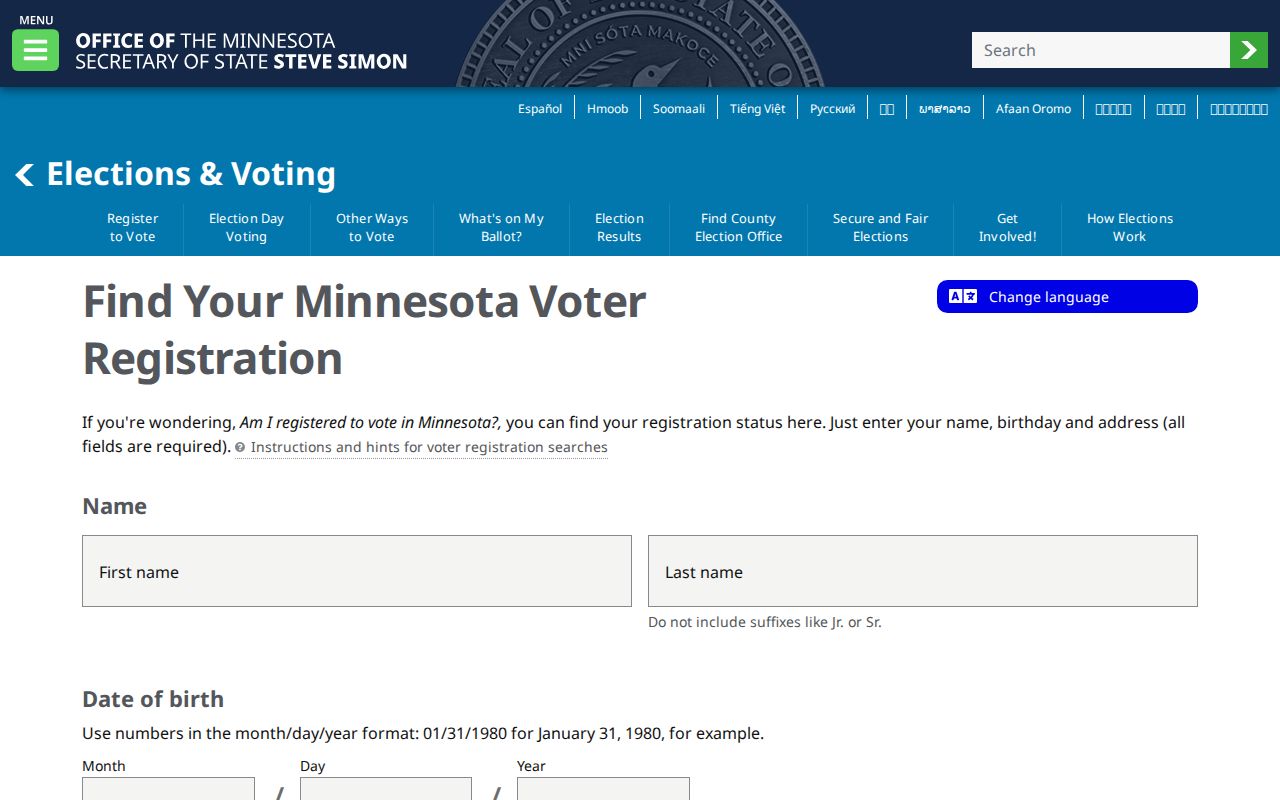
The form's ZIP, county, city, address, and unit choices show why an exact spelling and registered address matter.
Bloomington Court Records by Name
Minnesota Court Records Online, known as MCRO, searches statewide district-court cases and can be narrowed to Hennepin County. A person search starts with a last name and can add a first or middle name, date of birth, filing date, category, and county. Exact matching is the default. Try a name without the middle name, with an initial, or with an allowed trailing wildcard after two characters. The Sounds Like option broadens spelling but cannot be combined with a wildcard.
Remote access has limits. Pending criminal matters generally cannot be found by defendant name before conviction, and juvenile, adoption, sealed, expunged, protective, and other restricted matters are not ordinary remote name-search results. Public terminals at the Hennepin Records Center may show more, and court administration handles copy requests and certified copies.
MCRO Case Search provides the public interface pictured here.
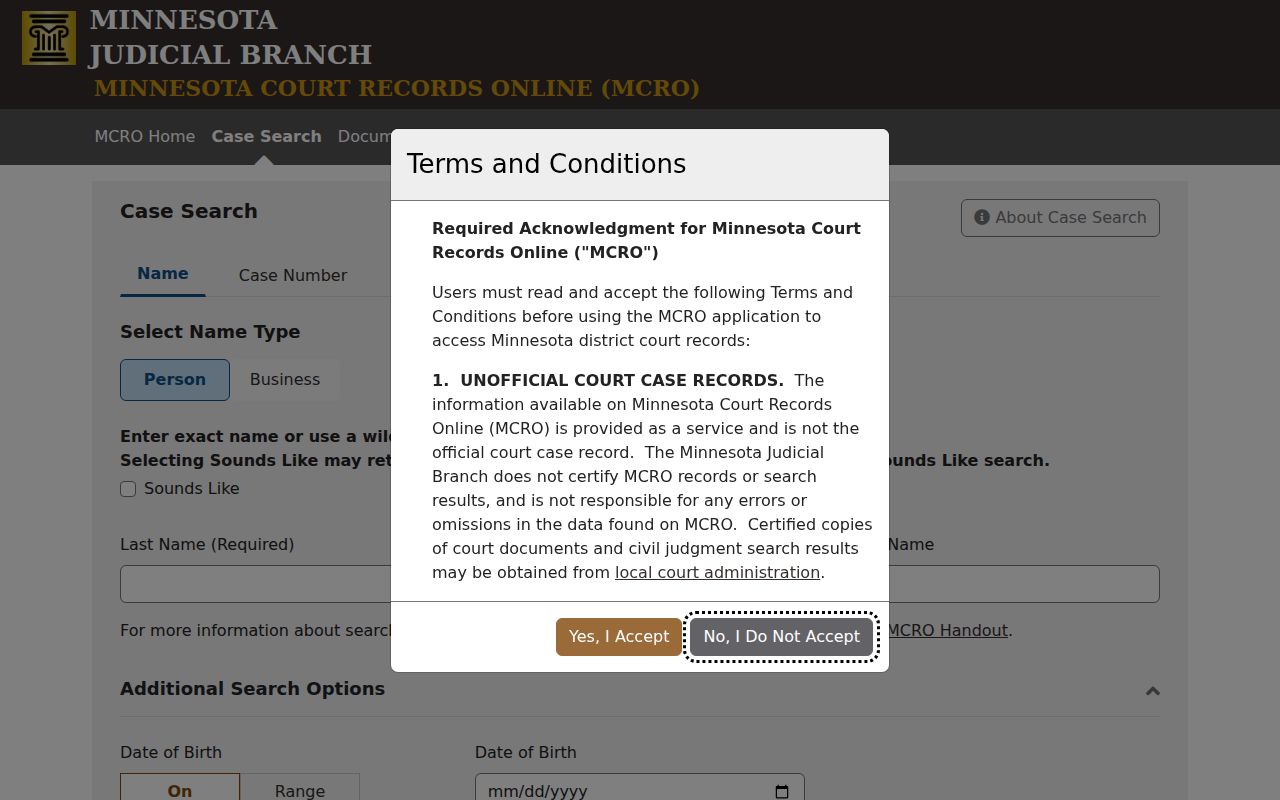
The separate case, document, hearing, and judgment tabs are reminders to search the record type that fits the question.
Bloomington Vital Record Routes
Birth, death, marriage, and divorce records use different custodians and rules. Minnesota Department of Health holds statewide birth records from 1900 and deaths from 1908. County offices can often be the faster certificate route. A birth application requires a qualifying relationship or legal authority and follows the restrictions in Minn. Stat. §144.225. Death records have a different public informational-copy route. MOMS is a name, county, and date marriage index, but the certificate comes from the county that issued the license. A divorce decree belongs with the district court.
Minnesota Vital Records explains the state and county pathways.
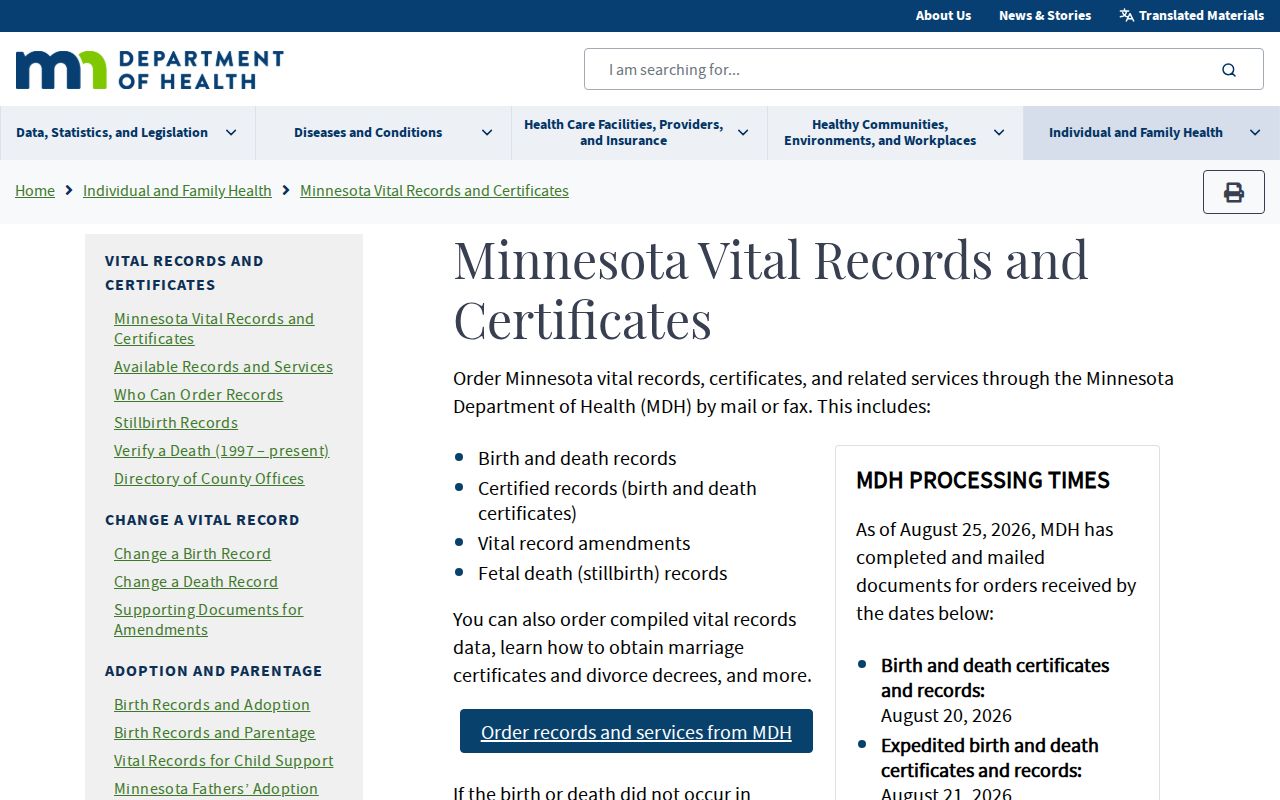
The state guidance directs requesters to the custodian and application that match the event rather than treating every life record as an open name search.
Recorded Parties in Hennepin
Hennepin's recorder keeps deeds, mortgages, liens, releases, plats, certificates of title, and other land-title instruments. PINS can supply the PID or legal description needed to continue. RecordEASE Public Search is limited free index access, but it needs a user ID and password supplied by email. The paid Pro service is a separate document-viewing option. Public computers at the Government Center, mail-copy requests, electronic requests, and Virtual Recorder are additional channels when the online index does not answer the question.
Recent recording history shown in PINS is limited to five years. That window is useful for a current question but cannot replace a full title trail. Recorder staff recommend legal description or individual and entity name searches, while an owner may request a free electronic deed or certificate of title using the address or PID.
| Limited free route | Request RecordEASE Public Search credentials by email. |
|---|---|
| In-person route | Government Center Skyway level, room SK-0353, weekdays 8 a.m. to 4:30 p.m. |
| Copy route | Request electronic, mailed, or certified copies from the Recorder / Registrar. |
| Research key | Use a PINS-derived PID or legal description first. |
Historical Bloomington Resident Directories
Historical work shifts from current parcels to dated household sources. Hennepin County Library's digital collection has four exact Bloomington city-directory titles for 1963 through 1966. The digitized run is a precise local source, not a reason to assume that a Minneapolis or nearby-suburb directory includes every Bloomington address. For years outside that run, use the regional directory shelf with state census, newspapers, cemetery records, deeds, and school material.
Hennepin Library Special Collections holds city directories, reverse address tools, clipping files, maps, photographs, yearbooks, digitized collections, and research databases. The Bloomington Historical Society's Old Town Hall research area has bound Bloomington newspapers from 1930 to 1960 and the 1970s. The full collection and reading method are on the Bloomington city directory page.
Bloomington's Four Digital Directories
The exact 1963 to 1966 run establishes both place and dates. Search the surname first, then browse the surrounding page. Directory typography can frustrate modern OCR: entries are often surname first, use abbreviated given names, put a spouse in parentheses, and use h, r, or b as residence marks. Ditto marks may also change how an entry is indexed. Women, children, and some households may not be listed.
Bloomington Data and Records is the municipal source shown below.
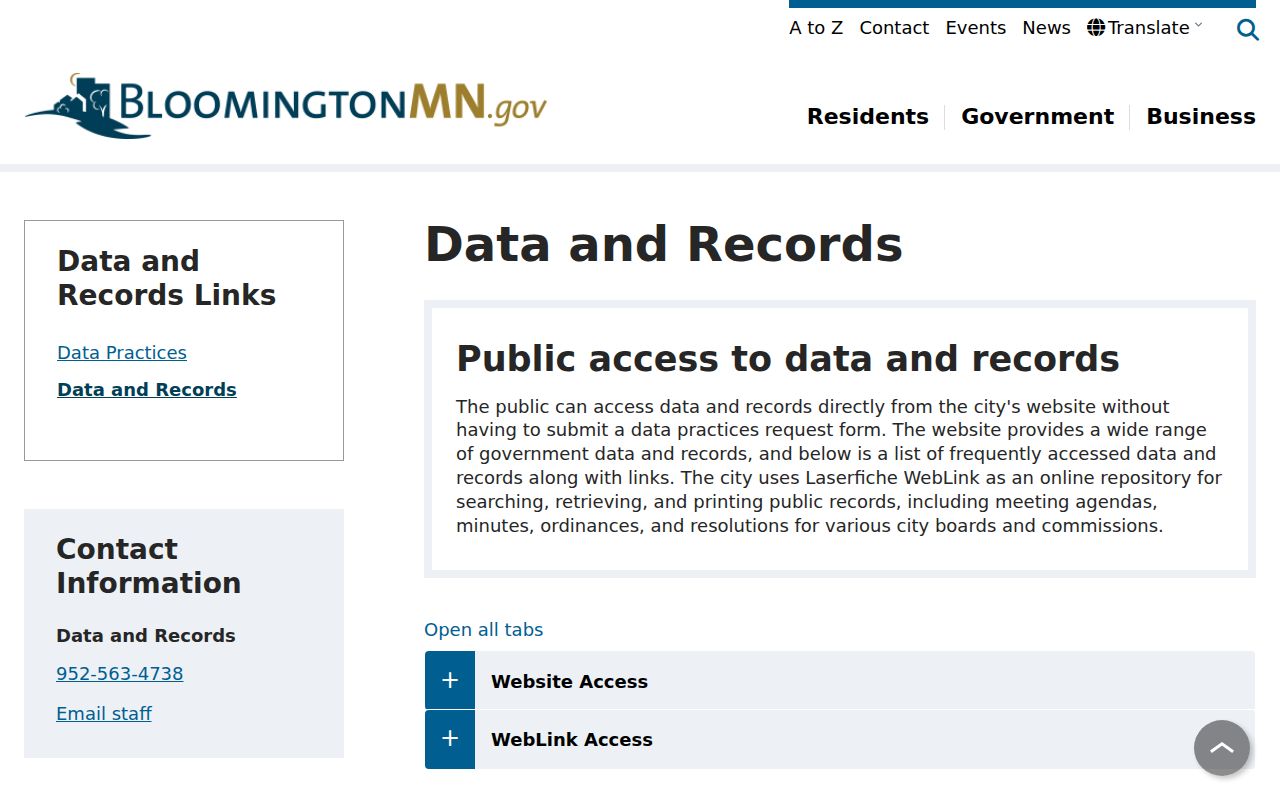
The municipal record portal complements dated directories by making city collections and request contacts easier to locate.
Bloomington City Records Access
Bloomington's Data and Records page is the direct route to city WebLink collections, including minutes, agendas, ordinances, resolutions, permits, plats, engineering, and planning material. WebLink helps establish civic context around a place or public action. The city also has a data-practices request path for records that are not directly posted. Ask for a named record series, date range, subject or address, fields needed, and preferred format. The city can explain a withholding or point to the relevant classification.
Bloomington Data Practices is the source shown here.
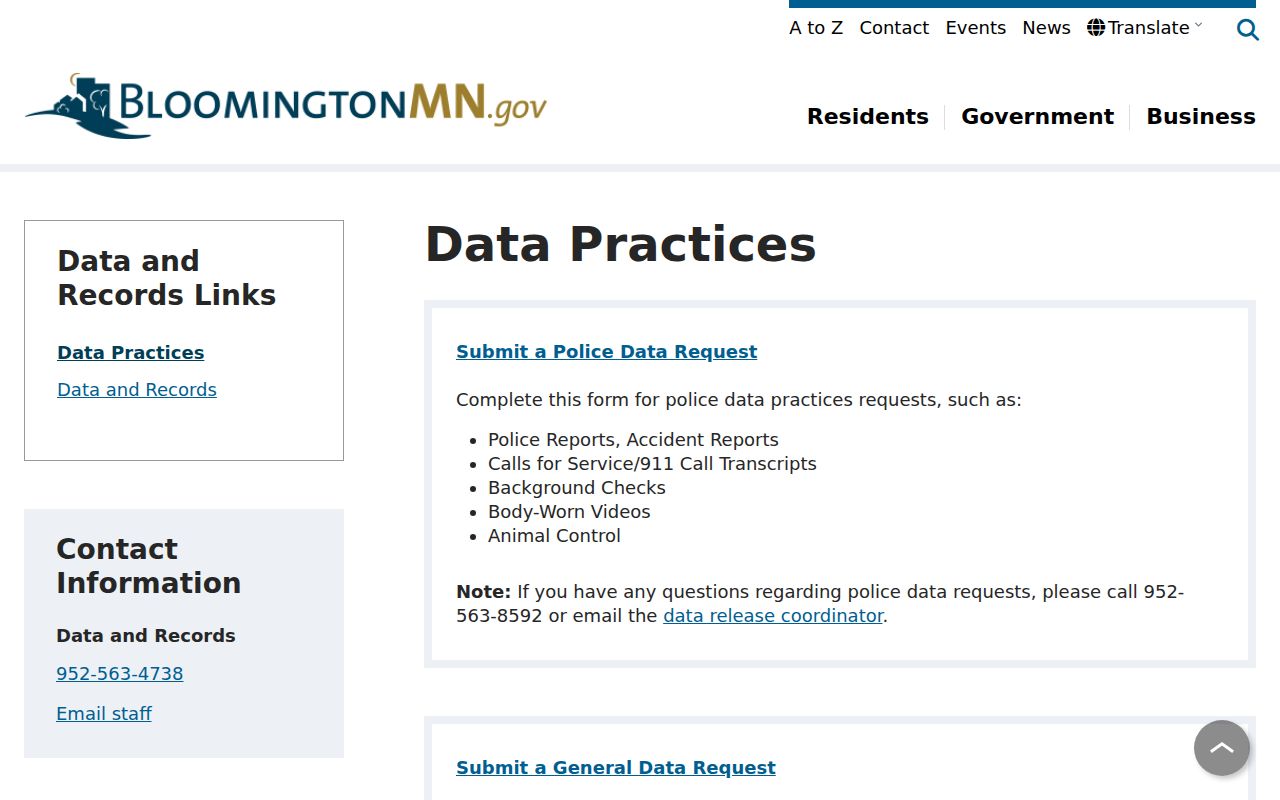
The request flow works best when it asks for a defined record rather than every item connected to a person or address.
Use the same city request channel when direct access stops short.
Bloomington State Lookup Limits
Minnesota's statewide systems can add a narrow check. The Department of Corrections locator searches adults in DOC custody by name or ID, but it is not a Hennepin jail roster and does not prove residence. The Secretary of State business search checks an entity name or filing number, while a filing address is not a physical-presence claim. License records are also role-specific. Use each to verify the published role, then return to a parcel, court, or historical record when the question is about a person or place.
Minnesota DOC Offender Locator provides the official state interface pictured here.
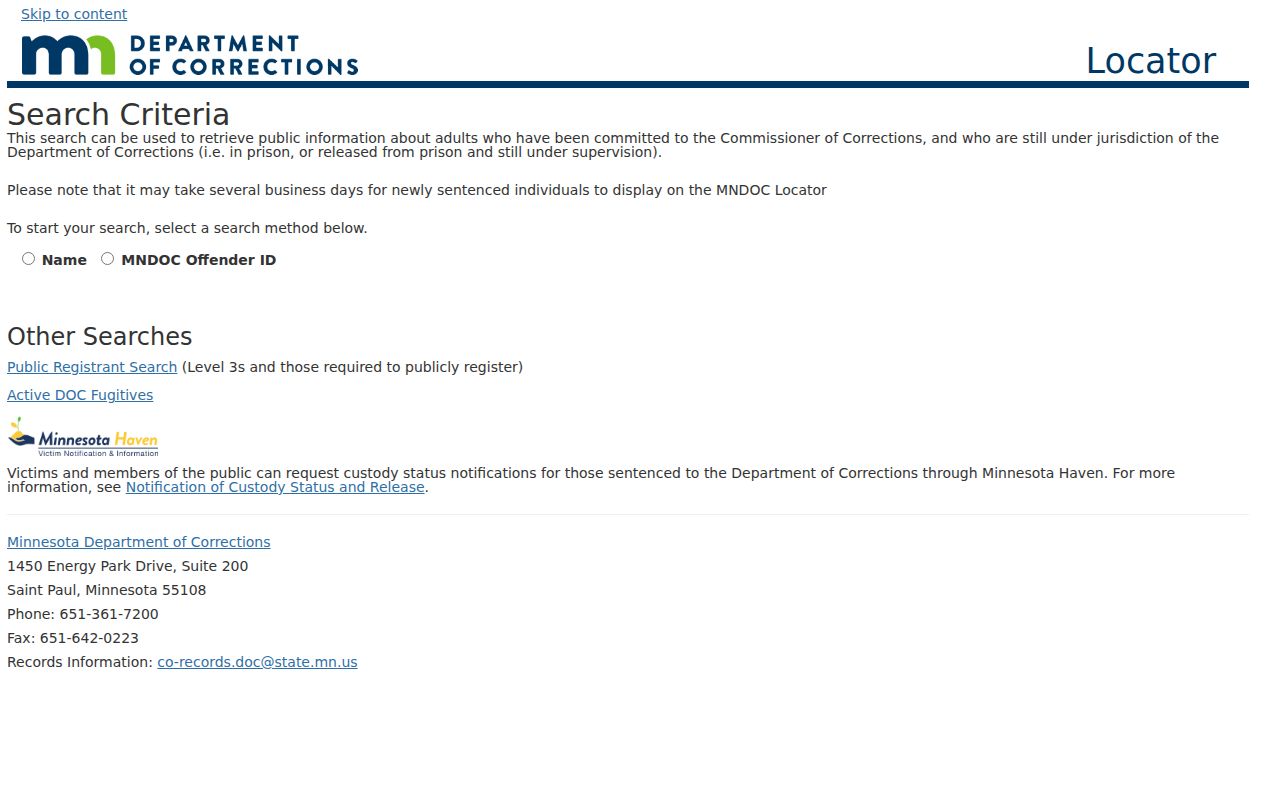
The name and ID search controls show the tool's custody focus rather than a general resident search.
Minnesota Secretary of State Business Search is another role-specific source.
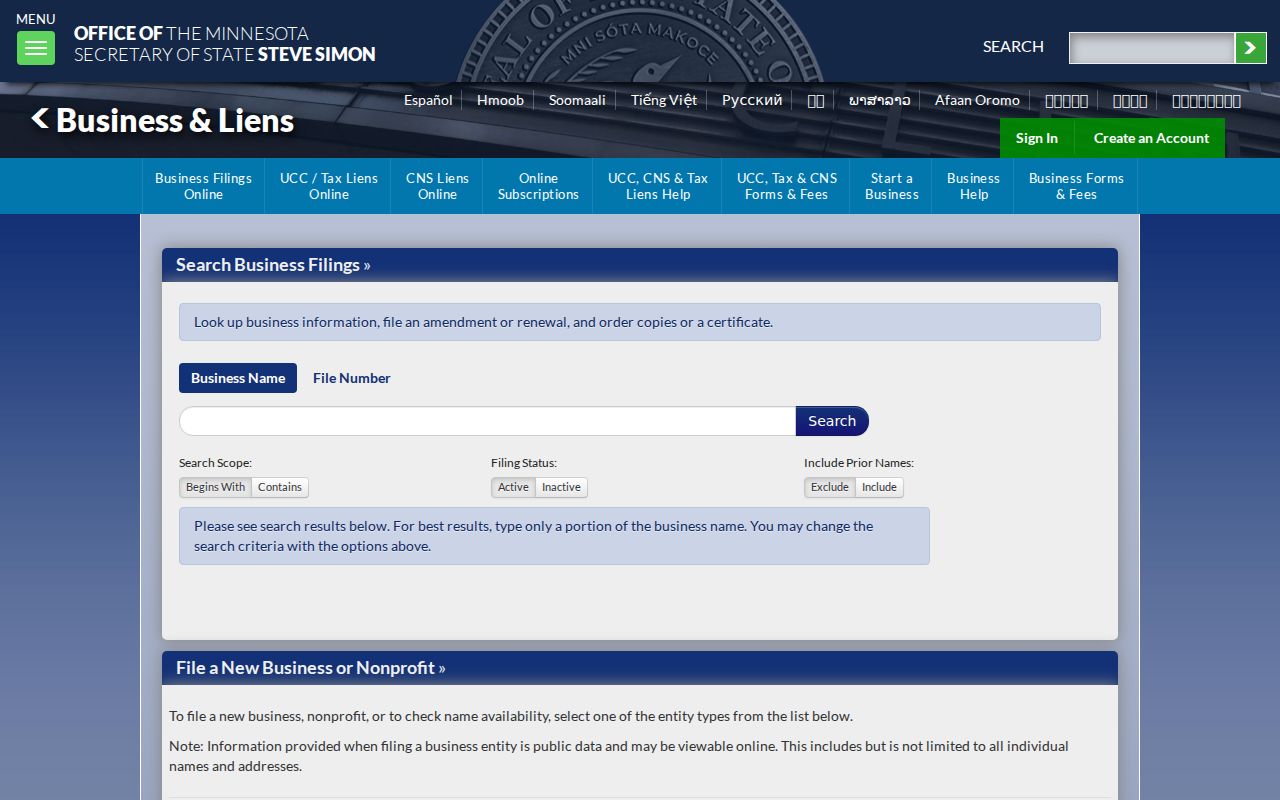
A business status or filing match is an entity record, not evidence of a person's current address.
Bloomington Address Geography Matters
Keep four address ideas separate: a situs address identifies the physical property, a tax or mailing address directs mail, a postal city and ZIP handle delivery, and a legal description or PID identifies land. They can differ without an error. The strongest Bloomington example is postal geography: the local 55420 post-office address uses Minneapolis, and city planning material says 55435 and 55439 are primarily outside Bloomington. Check USPS for delivery and PINS or GIS for municipal parcel context.
Historic research needs the same care. Before Bloomington became a city in 1960, a household may appear under a township, county, church, cemetery, or nearby post-office name. State census microfilm uses Bloomington-St. Anthony and Bloomington-Wayzata groupings on different rolls. Preserve the historic name and legal description instead of forcing an old record into a current city label.
Bloomington Record Checks and Privacy
Official sources and commercial people-finding products do different things. An official record has a named custodian, a stated scope, and a way to inspect, request, or correct the underlying item. A commercial result may be dated, incomplete, or unclear about its source. Use official portals for the final verification, and use an MGDPA request, court counter, recorder terminal, library, archive, phone, mail, or custodian form when an online index falls short.
| Path | Strength | Important limit |
|---|---|---|
| Official portal or index | Named custodian and search rules | May have date, field, or access gaps |
| Counter, library, or terminal | Can reach material not online | Hours and copy rules apply |
| Written request | Creates a clear request for a record | Classification and fees may apply |
| Commercial category result | May supply a lead to verify | Never substitutes for the original record |
Bloomington grew from a township record environment to a modern city and county system, but the record trail still has gaps. Keep a name, address, date, and source note for every match. That simple search record helps prevent a same-name error.